Andreuccio di Pietro
The DecameronAndreuccio di Pietro is a young horse dealer from Perugia whose first journey away from home turns into a single night of danger in Naples. He arrives with five hundred gold florins to buy horses, but his conspicuously displayed purse makes him a target. Stripped of his money and caught in successive perils, he escapes an open tomb by seizing a priest’s leg and frightening away the men gathered there. He leaves Naples with a ring rather than the horses he sought.
Identity and Departure
Andreuccio is introduced as a young horse-courser who has never before been away from home. Having heard that horses are cheap in Naples, he travels there with other merchants, carrying five hundred gold florins in his purse. He arrives on a Sunday evening near vespers and, after consulting his host, goes to the horse market the following morning.
At the market he sees plenty of horses and takes an interest in several, but agrees to buy none. In an effort to show that he is a serious buyer, he repeatedly draws out his purse in front of people passing by. The gesture exposes both his money and his inexperience: a Sicilian woman notices the purse while he is unaware of her, and recognizes an opportunity to take it.
Deception and the Fall
The woman lays her trap by pretending to be from Palermo and to be Andreuccio’s sister from Perugia. Her story gains him an invitation to her house, where she keeps him talking until late at night. When she withdraws to another room, he is left in her chamber with a young servant boy.
In the heat, Andreuccio takes off his doublet and hose and leaves them at the head of the bed. Needing to relieve himself, he asks the boy where he can go; the boy directs him through a door into a privy built over a narrow alley between two houses. Andreuccio steps onto a loose board. It gives way, and he falls with it to the bottom of the alley, where he is covered in filth but, by good fortune, not seriously hurt.
The fall is also the moment his host’s deception becomes unmistakable. The boy runs to tell the woman, who hurries to the chamber, finds Andreuccio’s clothing and the purse he had foolishly kept with him, and takes them. She then shuts the door through which he fell, leaving him outside and without his money or clothes. His misjudgment has made him vulnerable, but the story does not end with this theft: his later escape depends on his ability to act quickly when another danger arises.
Escape from the Tomb and Return
Near dawn, Andreuccio is trapped inside a tomb that has been opened by a group of men. When the newcomers debate who will enter, a priest volunteers, reasoning that the dead cannot harm the living. As the priest leans over the edge and begins to lower himself inside, Andreuccio suddenly rises and catches him by one leg, making it seem that he is about to pull the priest down into the tomb. The priest cries out and scrambles away; the others flee in terror, leaving the tomb open.
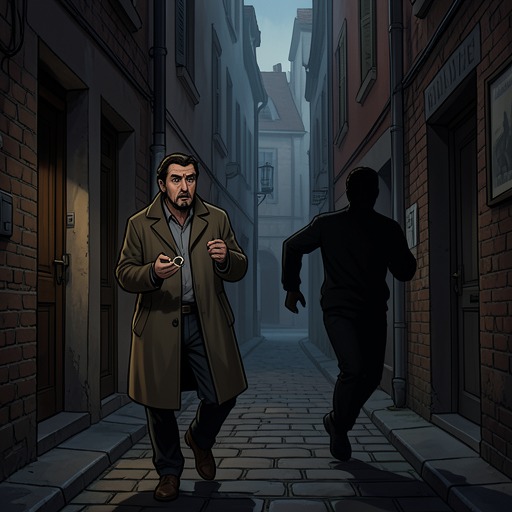
Andreuccio climbs out and escapes from the church by the way he entered. With a ring on his finger, he makes his way to the shore and then back to the inn. There he finds his companions and host, who have been worried about him through the night. On the host’s advice, he leaves Naples immediately and returns to Perugia. He has come to buy horses with a purse of florins; he goes home having invested what remains of his money in a ring.
Narrative Role
Andreuccio’s story turns on the contrast between the vulnerable newcomer at the market and the resourceful survivor at the tomb. At first, he displays his wealth without appreciating how others may use that knowledge, and accepts the woman’s invented kinship. The resulting fall is at once physical and financial: he lands in a filthy alley while the purse and clothing he left behind are taken.
At the tomb, however, a quick physical gesture reverses his position. He cannot overpower the group by force, but makes the priest believe the dead man is reaching for him, and the frightened men flee. The night’s repeated dangers leave him with little of what he brought to Naples, yet he gets out alive and returns home with a ring. The change in the object he carries marks the difference between his original purpose and the outcome of the journey.